
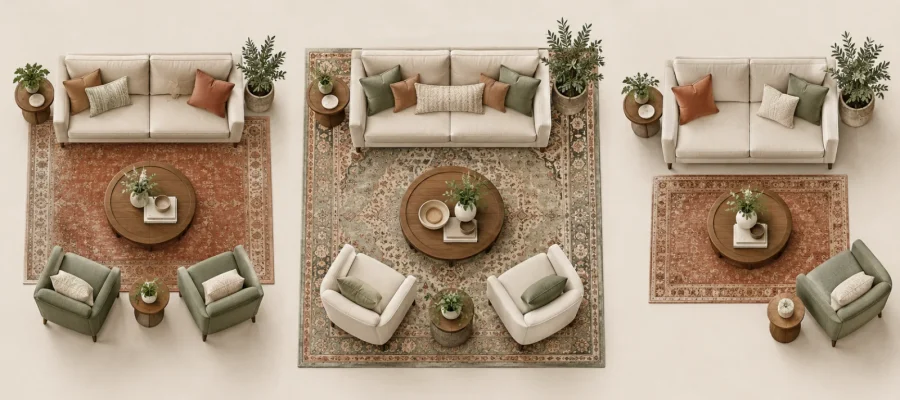
Choose a living room rug by testing how it connects the seating, rather than selecting a size from the room’s floor area alone. Mark two or three possible rectangles on the floor, place the furniture as you intend to use it and check doors, walking routes and exposed edges.
A rug should support the layout you want. It does not need to follow a single rule about how many furniture legs must touch it, particularly in an awkward room.
Start with the seating group
Measure the sofa, chairs and coffee table as a group. Include any chair that moves when someone sits down and any recliner that extends. Decide whether the rug’s main job is to connect several seats, create a soft area in front of one sofa or define a zone within an open room.
IKEA’s rug-sizing guide recommends relating the rug to the sofa’s width and explains both fully and partly supported seating arrangements. Use these as starting points for a floor test, rather than dimensions that every home must follow.
Three layouts worth testing
| Layout | When to try it | What to check |
|---|---|---|
| Front seating legs on the rug | You want to connect a sofa and nearby chairs without covering most of the room. | Keep the relationship deliberate across the seating group. |
| All seating on the rug | You want a clearly defined island within a larger space. | Include chair movement and furniture depth, not just the sofa width. |
| Rug mainly in front of the sofa | The room is compact or the rug has a limited purpose. | Check that the coffee table sits as intended and exposed edges do not interrupt the route. |
Photograph each taped outline from the same position. A photograph makes side-by-side comparison easier, but stand in the room as well: an attractive overhead arrangement can still be inconvenient to walk around.
A worked size comparison
Illustrative example: a sofa is 220 centimetres wide. Centre its width against the 300-centimetre edge of a 200-by-300-centimetre rug. That leaves 40 centimetres beyond the sofa at each end.
A 160-by-230-centimetre rug, oriented the same way, leaves only 5 centimetres at each end. Neither calculation proves that one option is right. It shows why the two outlines will frame the same sofa differently.
Now check the remaining dimensions. The larger rug may suit the chairs but reach into the entrance route. The smaller one may clear the doorway but leave one chair visually disconnected. Move the seating or test another size before treating either compromise as unavoidable.
Take the actual outline measurements to the shop. Product photographs often show furniture and room proportions that differ from yours.
Choose material and thickness after the outline
List the tasks the rug must tolerate: frequent vacuuming, dining nearby, pets, a wheeled chair or easy lifting for cleaning. Ask the supplier which construction and cleaning instructions fit those uses. A washable label should be checked against the rug’s dimensions and the appliance requirements, not just the word washable.
Check the combined thickness of the rug and any recommended underlay against nearby doors. Ask for backing compatibility with your particular floor. Avoid assuming that a rug or pad will stay put simply because it feels heavy in the showroom.
For ideas on coordinating a calm seating area, see our article on a Zen-inspired atmosphere.
Common sizing mistakes
- Buying the size used in an inspiration photograph.
- Measuring the sofa while ignoring nearby chairs.
- Forgetting an opening door or extending recliner.
- Choosing pile and backing before checking everyday care.
Before buying
- Compare at least two taped outlines.
- Test seating and door movement.
- Check thickness, underlay and floor compatibility.
- Read cleaning and return conditions.
Questions about awkward rooms
Can the rug be narrower than the sofa?
Yes, if that is a deliberate arrangement that works in the room. Test the result at full size. Do not rely on a close-up photograph to judge whether the edges feel intentional.
Should the rug be centred in the whole room?
Not necessarily. Start by centring it on the seating group or the zone it defines. A room can contain circulation space or another activity that makes whole-room centring unhelpful.
Ultimas Entradas Publicadas
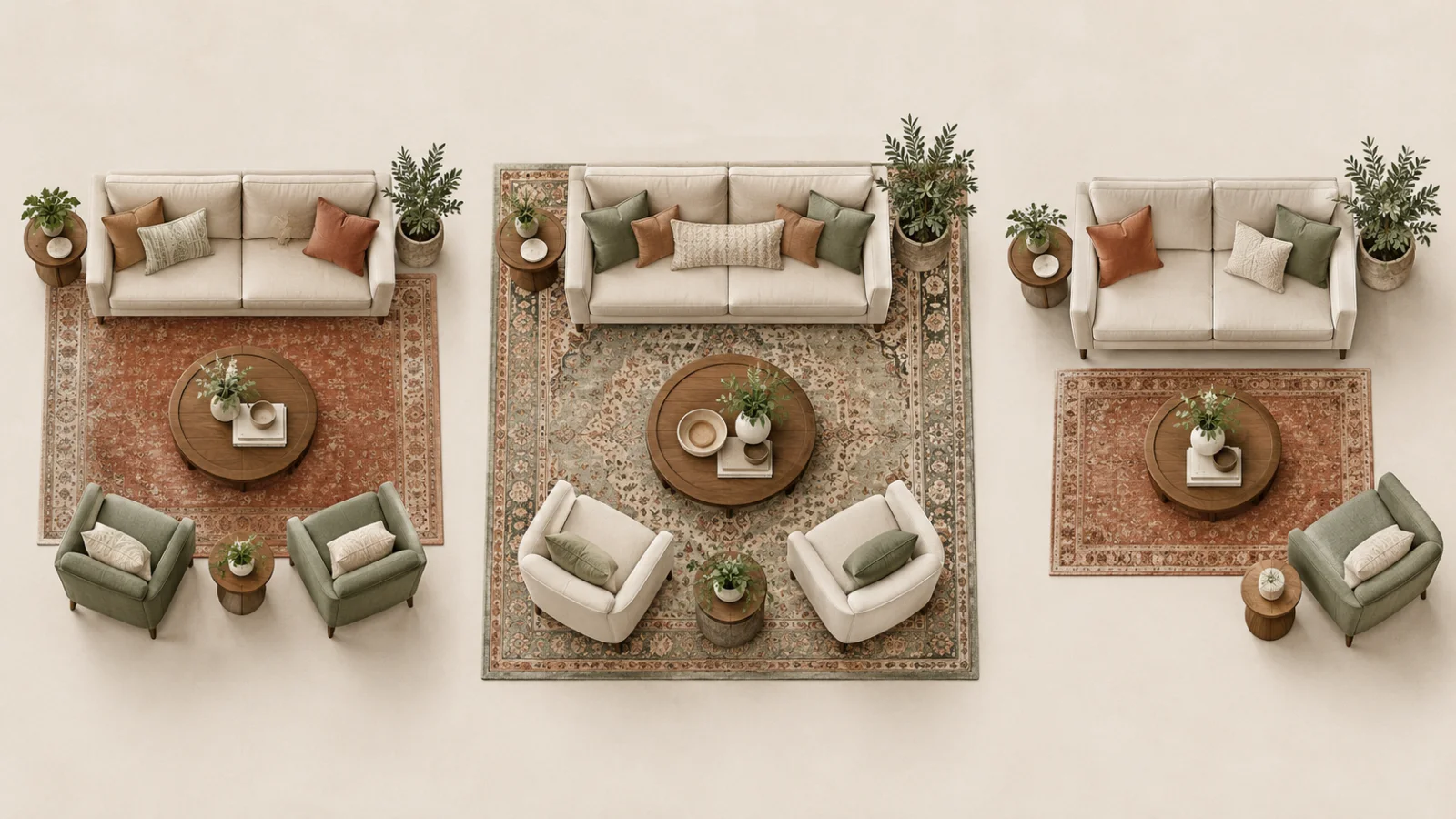
Living Room Rug Sizes: Three Layouts to Test at Home
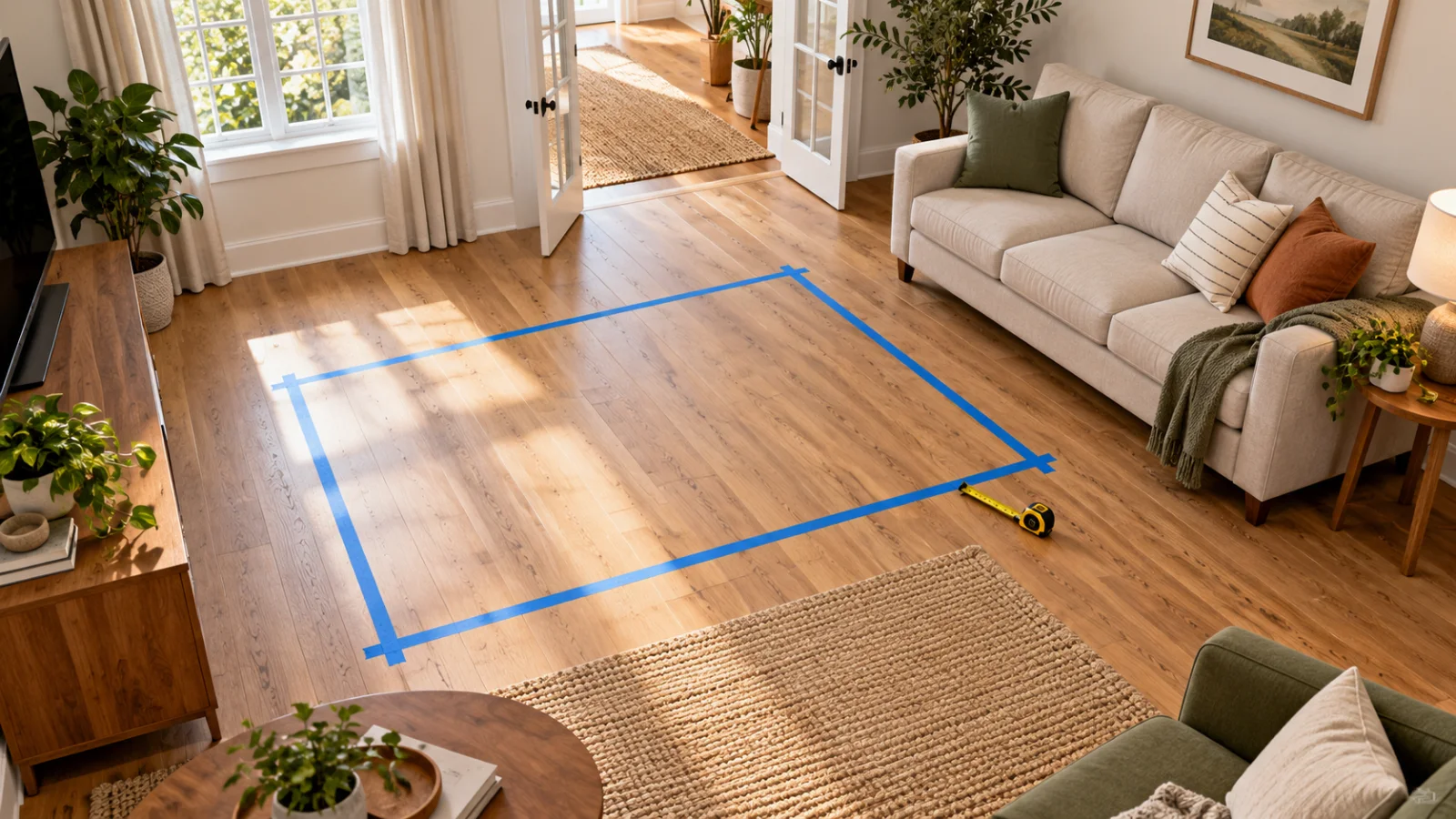
How to Measure for a Sofa Before You Buy
Quartz vs Laminate Countertops: A Practical Buying Guide
Bathroom Flooring: Porcelain Tile vs Luxury Vinyl

How to paint a wall without traces (roller)?

Which color in concrete concrete to choose?

Place in the new skull design table

Cement cement texture
How to paint a room: what color and what kind of paint to choose?
