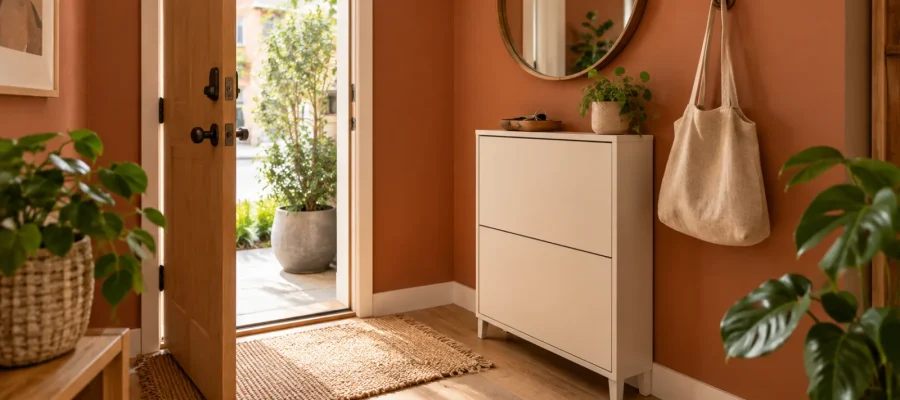
The most useful rental-friendly entryway storage gives everyday items an obvious home while leaving the entrance easy to use. Start with the door and walking route, then add the smallest storage that solves your actual daily problem. A slim cabinet, a tray and a few suitable hooks can work better than a full hallway furniture set.
“Rental-friendly” does not automatically mean damage-free or permitted. Check the lease and obtain any required landlord agreement before changing walls, doors or finishes.
Start with what arrives at the door
List what you carry home on an ordinary day. Separate items that belong at the entrance from things that can go straight to another room. Shoes worn daily need a convenient place; seasonal equipment does not necessarily need the same prime location.
| Daily problem | Small storage response | Check before buying |
|---|---|---|
| Missing keys | A shallow tray | A stable location within easy reach |
| Shoes across the floor | A compact rack or closed cabinet | Usable interior size and opening space |
| One everyday bag | A suitable hook or dedicated shelf | Loaded weight and attachment requirements |
| Paper accumulating | A small sorting pocket | A routine for emptying it |
Measure with the door open
A cabinet that fits against the wall may still interfere with the entrance. Open the front door through its normal movement and check the handle, door closer and nearby cupboard doors. Include the cabinet’s handles and opening doors in your measurement, rather than using only its closed depth.
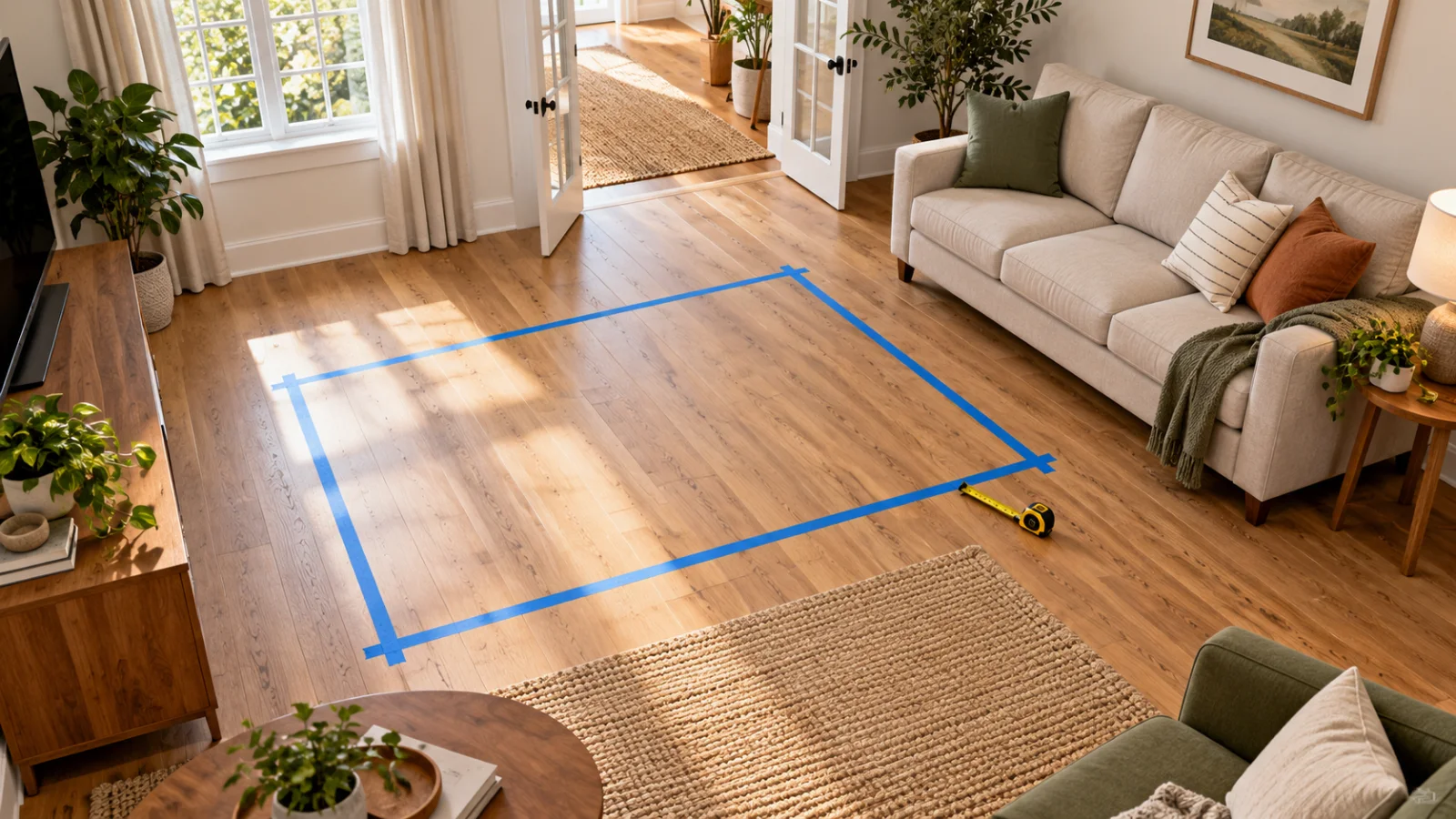
Use paper or cardboard to represent the furniture footprint. Walk through carrying a bag, take off your shoes, and repeat the movement with another household member nearby. This is a practical fit check, not a substitute for applicable access requirements.
Keep escape routes usable. The National Fire Protection Association’s home escape guidance says routes should be clear and doors and windows should open easily. Do not use an arbitrary furniture clearance as a universal building-code rule.
Choose an installation you can actually support
Freestanding storage
Look beyond the label “no drilling.” Check the furniture’s instructions for required anchoring. If anchoring is required and you cannot obtain permission or install it correctly, choose another design rather than skipping that step.
Removable adhesive hooks
Match the exact product to the surface and loaded item. 3M’s Command guidance says limits vary by product and that adding extra strips does not automatically increase capacity. Follow the package’s surface preparation, waiting time and removal instructions; do not assume an adhesive is suitable for textured paint.
For a door-mounted organizer, confirm that the door still closes and operates correctly. Avoid an arrangement that interferes with locks, seals or required door hardware.
An illustrative small-entry layout
Consider an apartment entrance where a deep bench makes the hallway feel crowded. The household mainly needs space for four regularly worn pairs of shoes, keys and one work bag.
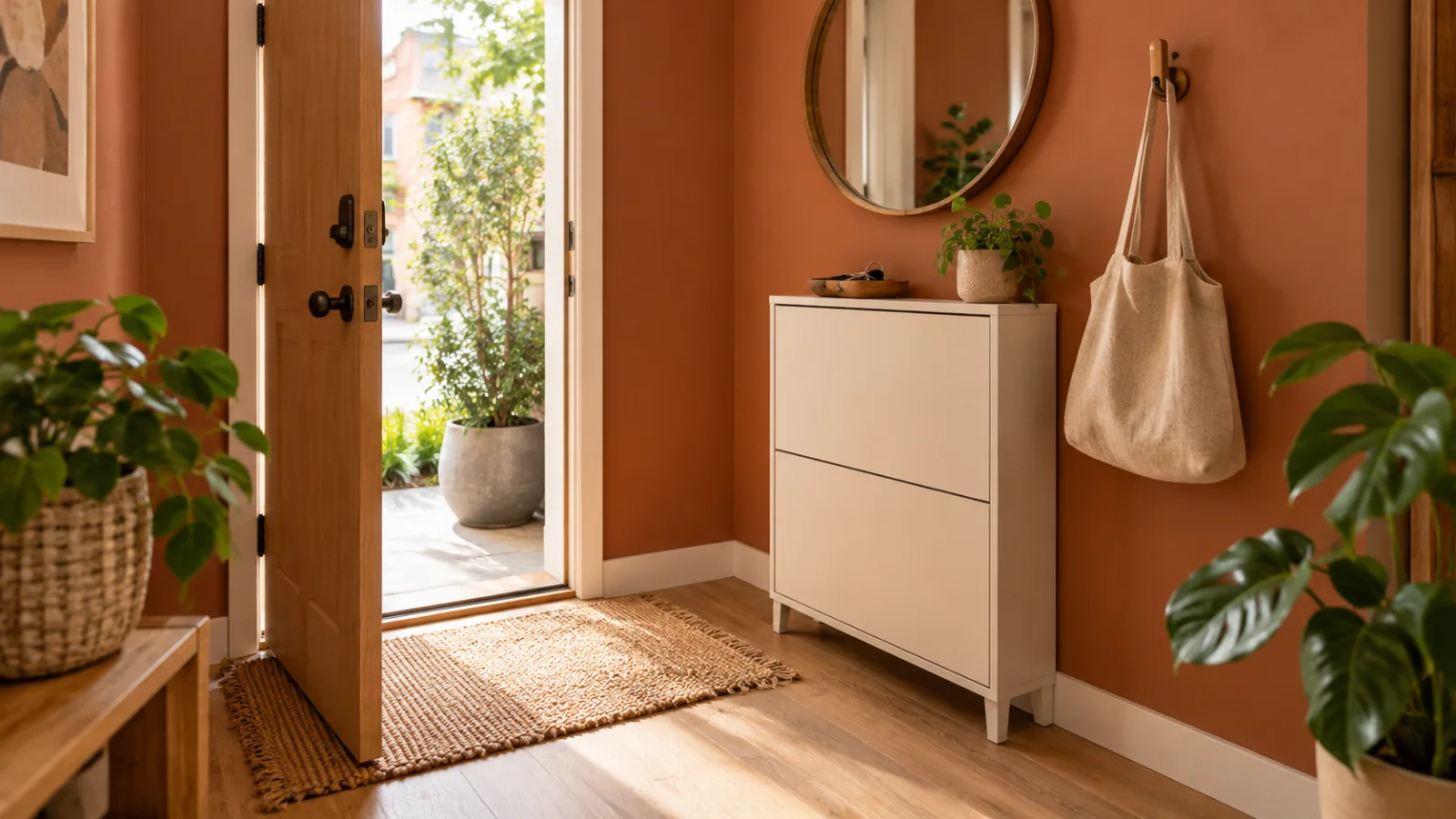
Instead of buying a larger bench, they map the daily route and select a shallower shoe cabinet that accommodates the shoes without forcing the door against it. A small tray sits on top. The bag gets a separately rated hook on a permitted surface. Less-used shoes move to a bedroom cupboard.
The change works because it reduces what the entryway must store. It does not depend on hiding an unlimited amount of belongings behind a narrow cabinet. If you are also considering the wall’s appearance, see our article on a concrete finish in an entrance hall.
Common mistakes
- Buying a cabinet before checking its usable internal dimensions.
- Letting open baskets expand into the walking route.
- Treating a hook’s capacity as the weight of an empty bag.
- Skipping furniture anchoring instructions because the home is rented.
- Creating a landing zone without deciding when it gets cleared.
A short setup checklist
- Confirm the permitted installation.
- Test door movement and the furniture footprint.
- Check loaded weights and manufacturer instructions.
- Assign one place to each daily item.
- Remove items that belong elsewhere.
Frequently asked questions
Is a bench necessary in a small entryway?
No. Add seating when the household needs it and the space supports it. If a bench obstructs the route, a different place to sit nearby may be more practical.
Can removable hooks replace a coat rack?
Sometimes, for suitable items and surfaces. Check each hook’s rating with the item fully loaded. Several heavy coats or bags may require a different product or an approved mechanical installation.
Ultimas Entradas Publicadas
Rental-Friendly Entryway Storage Without Blocking Access

Curtains vs Blinds: Privacy and Light Control

Aluminum vs Wood Outdoor Furniture: How to Choose

Balcony Container Gardening: Sun, Pots and Watering

Closet Organizers: Measure Before Choosing a System
Bathroom Exhaust Fans: What to Check Before Buying
Peel-and-Stick Wallpaper: Wall Prep and Roll Planning

Layered Living Room Lighting: Lumens, Kelvin and Placement

Living Room Rug Sizes: Three Layouts to Test at Home