
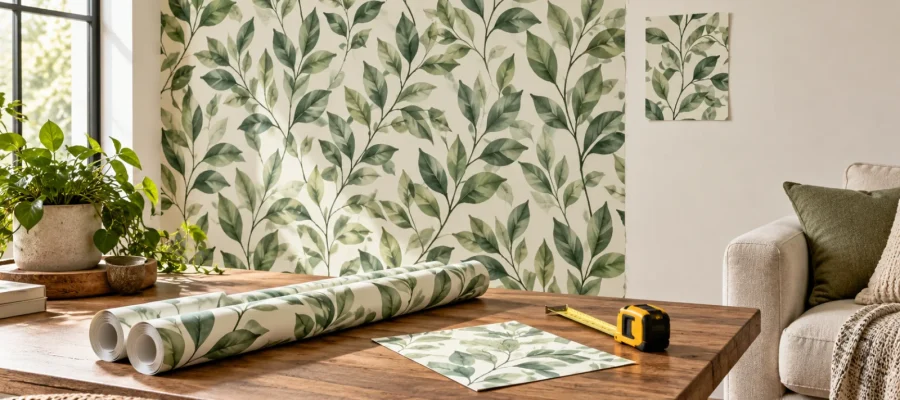
Successful peel-and-stick wallpaper starts with a compatible wall and a realistic cutting plan. The pattern matters, but neither an attractive print nor a generous square-footage estimate can rescue weak paint, unsuitable texture or too few full-height strips. Before ordering, inspect the surface, test a sample and calculate how the actual roll dimensions fit your wall.
Check the wall before choosing the pattern
Look closely at the area in daylight. Is the paint sound, or does it flake when gently touched? Are there damp patches, greasy marks or pronounced texture? Fix the underlying problem before covering it. Wallpaper is a finish, not a repair for moisture or a method of holding damaged paint together.
Compatibility varies by product. For example, Tempaper’s surface guidance favors smooth, sound painted walls and recommends checking paint cure instructions and testing questionable finishes. Treat the instructions for your chosen paper as the final reference; a preparation method suitable for one adhesive may be unsuitable for another.
| What you find | What to establish before ordering |
|---|---|
| Fresh paint | Whether it has fully cured according to the paint and wallpaper instructions |
| Textured finish | Whether the manufacturer approves that specific texture |
| Loose or damaged paint | What repair is needed before a sample test |
| Rental property | Whether the lease permits wallpaper and any necessary preparation |
Test adhesion and removal
Order a sample before committing to several rolls. Apply it in an inconspicuous area using the supplied directions, then leave it for the manufacturer’s recommended test period. Check whether edges lift and whether the texture remains visible. Remove the test as directed and inspect the paint underneath.
A good sample result reduces uncertainty but does not guarantee damage-free removal everywhere. Different sections of the same wall may have different paint histories. Keep the packaging and photograph the wall beforehand if documenting its condition is useful.
Calculate strips, not just wall area
Measure the wall width and its height in several places. Use the greatest required drop length, then include the trimming allowance specified for the product. Next, record the roll’s usable width, length, pattern repeat and matching method. Some papers overlap at seams; others meet edge to edge.
Divide wall width by usable strip width and round up. Then establish how many correctly matched drops each roll provides. Pattern alignment can consume material at the beginning of a roll as well as between drops. Do not automatically subtract every window and socket from your order: small openings often leave offcuts that cannot replace a full strip elsewhere.
An illustrative roll calculation
Imagine a wall 120 inches wide and 96 inches high. A hypothetical paper has a usable width of 20 inches and a roll length of 240 inches. With a 4-inch total trimming allowance, a free-match drop is 100 inches long. The wall needs six strips, and each roll supplies two: three rolls are the preliminary requirement.
Now imagine a 12-inch straight-match repeat. A 108-inch drop may allow the pattern to align while preserving trimming room, and two drops still fit within the hypothetical roll. Starting alignment, defects and installation mistakes can change the order. Confirm the cutting layout with the supplier’s calculator before purchasing, and check the batch policy if ordering an additional roll.
Avoid the mistakes that waste material
Do not cut every roll immediately. First confirm the pattern direction, starting position and first seam. Plan where a prominent motif will land relative to the bed, sofa or doorway. Keep usable offcuts labeled, and inspect the supplied rolls before the return period ends. For color inspiration, see our pink wallpaper ideas.
Before-you-order checklist
- Wall condition and product compatibility checked.
- Paint curing and sample test completed.
- Wall dimensions, seam method and repeat recorded.
- Full-height strips mapped on paper.
- Batch, returns and spare-material policy confirmed.
Frequently asked questions
Can peel-and-stick wallpaper cover a rough wall?
Only if the chosen manufacturer approves that surface and the sample performs acceptably. Thick paper may disguise some texture visually without solving poor adhesion. Do not assume a busier pattern makes an unsuitable wall suitable.
Is an extra roll always necessary?
No fixed allowance suits every project. Large repeats, awkward corners and future repairs can justify more material. Base the decision on a cutting plan, available batch stock and the supplier’s return conditions.
Ultimas Entradas Publicadas
Peel-and-Stick Wallpaper: Wall Prep and Roll Planning

Layered Living Room Lighting: Lumens, Kelvin and Placement

Living Room Rug Sizes: Three Layouts to Test at Home
How to Measure for a Sofa Before You Buy
Quartz vs Laminate Countertops: A Practical Buying Guide
Bathroom Flooring: Porcelain Tile vs Luxury Vinyl

How to paint a wall without traces (roller)?

Which color in concrete concrete to choose?

Place in the new skull design table
