
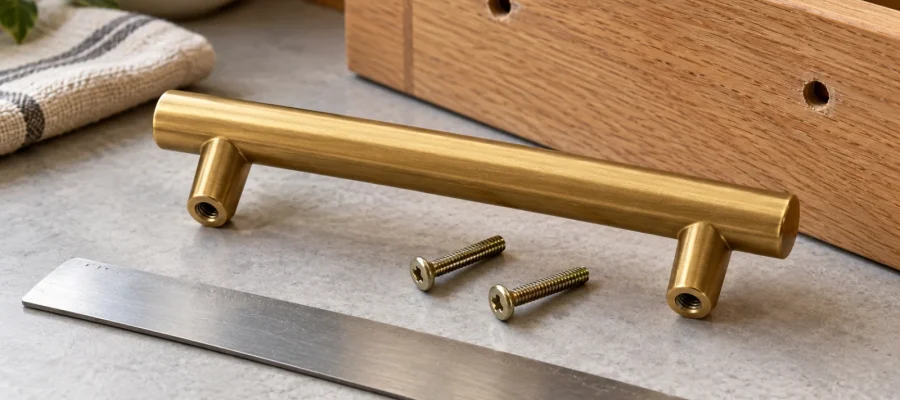
To measure cabinet handles center to center, measure from the middle of one mounting hole to the middle of the other. This is the hole spacing, often listed as CTC. It is different from the handle’s overall length. Match the required spacing first, then check the handle’s projection, base coverage and screw compatibility.
For replacements, inspect several doors and drawers before assuming every handle in the kitchen uses the same size.
Know which dimension you are reading
| Dimension | What it describes | Why it matters |
|---|---|---|
| Center-to-center | Distance between mounting-hole centers | Determines whether the existing holes align |
| Overall length | End-to-end handle length | Affects appearance and nearby clearance |
| Projection | How far the handle stands out | Affects grip and interference with adjacent fittings |
| Base size | The area around each mounting point | May cover or expose existing marks |
Manufacturers list these separately. For example, Amerock’s Crawford specifications show a 96 mm center-to-center option with an overall length of 119 mm. A handle described as 119 mm long should therefore not be assumed to fit 119 mm hole spacing.
Measure existing handles in five steps
- Select a representative pull. Check whether doors, narrow drawers and wide drawers use different hardware.
- Remove it carefully. Support the handle while removing the mounting screws, keeping the parts together.
- Measure the mounting centers. Use the back of the handle or the existing cabinet holes, whichever gives the clearest measurement.
- Record the units. Write the value with “mm” or “in,” and compare it with the manufacturer’s technical drawing.
- Check another piece. Confirm the measurement before ordering the complete quantity.
If a ruler makes the center difficult to judge, measuring between matching edges of two equal-diameter holes can help you cross-check the distance. Do not round an uncertain reading to the nearest popular size and hope that the screws will pull the handle into position.
Check more than hole spacing
Inspect the old handle’s footprint. A narrower new base can expose a ring, finish difference or damaged area that the old hardware covered. Order one sample if the finish and base coverage are important.
Next, compare projection and grip. A handle can fit the holes but still be awkward beside an appliance or another opening door. Test it in the most constrained location before repeating it throughout the room.
Check the supplied screw specification and the thickness of the actual mounting assembly. A drawer front may include more material than a cupboard door. Use the hardware manufacturer’s specified screw thread and suitable length; screws that look similar are not necessarily interchangeable.
What if the replacement does not match?
Do not force the screws sideways or enlarge visible holes just to make a near-match fit. Recheck the measurement and the drawing first.
An adjustable replacement can sometimes work, but it must cover the required range. Liberty’s Adjusta-Pull range, for example, specifies different hole-spacing ranges for different designs and lengths. “Adjustable” is not a promise that every version fits every cabinet.
If changing the hole pattern is necessary, decide how the original holes will be repaired and finished before drilling. Keep any template aligned to a consistent cabinet reference edge, and verify one installation before repeating it.
An illustrative ordering mistake avoided
A homeowner measures a pull from tip to tip and records roughly 120 mm. Before buying, they remove it and find that the mounting centers are 96 mm apart. They then compare a 96 mm replacement’s drawing, base size and projection rather than searching only for a 120 mm handle.
The sample fits the existing holes, but its smaller bases expose old marks. Finding that on one drawer gives them a chance to choose wider bases or plan refinishing before buying the full set. Coordinate the final finish with the rest of your kitchen design.
Before-you-order checklist
- Record CTC and overall length separately.
- Check more than one door and drawer.
- Compare the exact product drawing.
- Check projection, base coverage and screw requirements.
- Test one sample before ordering the full quantity.
Frequently asked questions
Can a longer handle use my existing holes?
Yes, if its center-to-center spacing matches, or an approved adjustable design covers that spacing. Overall length alone does not determine mounting compatibility.
Are cabinet knobs measured the same way?
A single-hole knob does not have two-hole CTC spacing. Check its diameter, projection, base coverage and mounting screw requirements instead.
Ultimas Entradas Publicadas
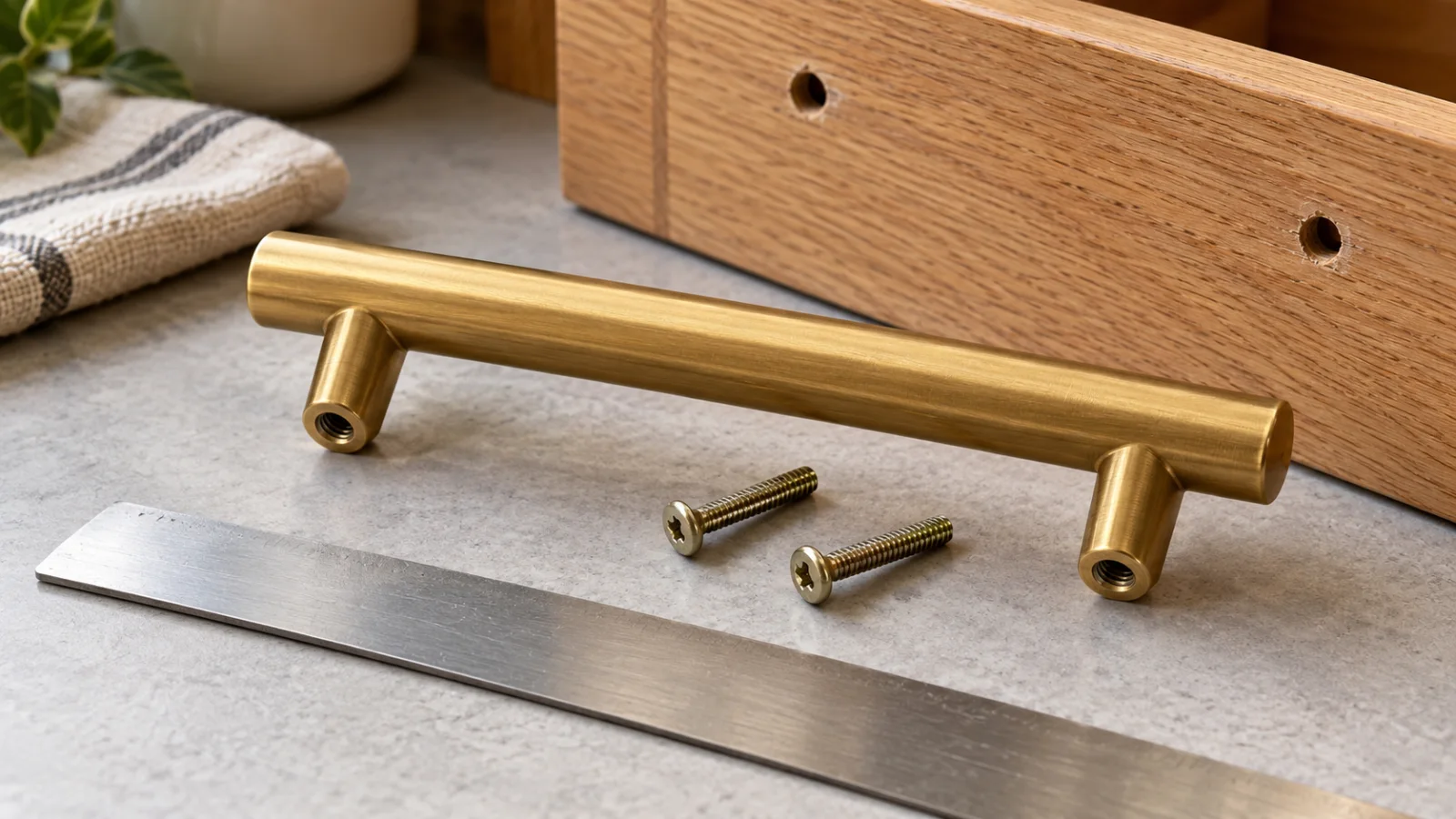
Cabinet Handles: How to Measure Center-to-Center Correctly
Kitchen Backsplash Materials Compared: Cleaning, Fit and Finish
Rental-Friendly Entryway Storage Without Blocking Access

Curtains vs Blinds: Privacy and Light Control

Aluminum vs Wood Outdoor Furniture: How to Choose

Balcony Container Gardening: Sun, Pots and Watering

Closet Organizers: Measure Before Choosing a System

Bathroom Exhaust Fans: What to Check Before Buying
Peel-and-Stick Wallpaper: Wall Prep and Roll Planning