
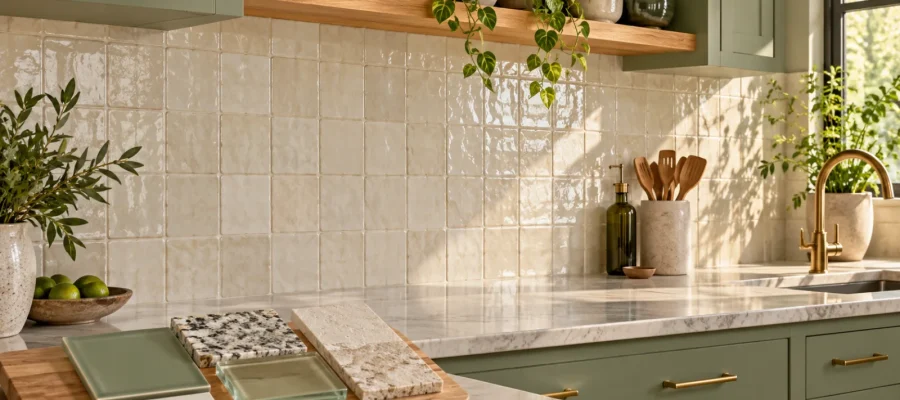
Choose kitchen backsplash materials by comparing cleaning, installation and the look of the complete wall. For a straightforward shortlist, begin with ceramic or porcelain products approved for the intended location, then compare glass, stone or panels if they better suit the design. Judge the exact product and installation system rather than assuming every example of a material performs alike.
The backsplash should work with your countertop and cooking routine. A beautiful sample is only the first part of that decision.
Compare materials as complete choices
| Material | What to evaluate | A question for the supplier |
|---|---|---|
| Ceramic tile | Glaze, edge finish, pattern and number of joints | Which grout and cleaning products suit this tile? |
| Porcelain tile | Format, cuts, edge treatment and installation scope | How will exposed edges and outlets be finished? |
| Glass tile | Reflections, backing and appearance of the installed sample | Which setting system is approved for this exact product? |
| Natural stone | Variation and the maintenance instructions for that stone | Which cleaners and protective treatments are appropriate? |
| Sheet or panel system | Seams, edge details and location approval | Is this system approved behind my specific appliance? |
Daltile’s care guide separates ceramic and porcelain, glass and metal, and natural-stone care. That distinction matters: do not choose a cleaning routine from a photograph or assume the same cleaner suits every surface.
Check the wall and appliance requirements first
Before ordering, establish what the existing wall is made of and whether it needs preparation. Ask the installer to explain the proposed substrate, adhesive, joints and edge details together. An attractive facing material does not correct an unsuitable surface behind it.
At the cooking area, consult the appliance instructions and the backsplash manufacturer’s location and clearance requirements. A product described as washable is not automatically approved for every position near heat.
Movement also needs planning. The Tile Council of North America explains that tile installations must accommodate differing expansion and contraction. Ask how the chosen installation handles changes of plane and adjacent surfaces rather than demanding a completely rigid, seamless result.
Use samples to test the actual combination
Place shortlisted samples upright against the wall with the countertop visible below. Look during daylight and under the kitchen’s evening lighting. A reflective surface may appear quite different beneath cabinet lighting than it does flat on a showroom table.
Include the proposed grout color and an edge sample if possible. For patterned or variable products, view enough pieces to understand the range. One unusually quiet stone sample cannot represent every piece in a varied selection.
Compare the backsplash from the room’s main entrance too. A pattern that is interesting at arm’s length can become the dominant feature across an open-plan space. For broader context, see our earlier kitchen design article before deciding which surface should attract the most attention.
Count the details in the installation quote
Compare quotes using the same scope: preparation, material, setting products, grout, flexible joints, cuts, trims, outlet treatment, removal and waste. A low material price alone does not reveal the finished project cost.
Larger pieces reduce the number of visible joints, but they also change handling and cutting needs. Small mosaics create another set of decisions around alignment and joint appearance. Ask for the complete arrangement rather than choosing size solely to avoid grout.
An illustrative material decision
Imagine a household that cooks daily and already has a strongly patterned countertop. Its first choice is a highly textured, contrasting mosaic. After comparing samples, the household decides that this would introduce a second competing pattern and a cleaning routine it does not want.
It selects a quieter glazed tile instead, checks a sample with the intended grout, and asks the installer to show the exposed edge detail. Another household could reasonably prefer the mosaic; the useful step is matching the decision to the room and routine.
Common mistakes and final checklist
- Do not treat all stone, glass or panel products as interchangeable.
- Confirm approval for the exact location and appliance arrangement.
- Review installed samples, grout and exposed edges.
- Agree on preparation and joint details before work starts.
- Keep the product’s cleaning and maintenance instructions.
Frequently asked questions
Is porcelain always better than ceramic for a backsplash?
No universal ranking replaces a product check. Compare the wall application, finish, installation and maintenance needs of the actual tiles. The best choice should solve your kitchen’s requirements.
Does a backsplash need to match the countertop?
It can coordinate without matching. Compare undertones, pattern scale and contrast together. Keeping one surface quieter is a useful design option when the other already has a strong pattern.
Ultimas Entradas Publicadas
Kitchen Backsplash Materials Compared: Cleaning, Fit and Finish
Rental-Friendly Entryway Storage Without Blocking Access

Curtains vs Blinds: Privacy and Light Control

Aluminum vs Wood Outdoor Furniture: How to Choose

Balcony Container Gardening: Sun, Pots and Watering

Closet Organizers: Measure Before Choosing a System
Bathroom Exhaust Fans: What to Check Before Buying
Peel-and-Stick Wallpaper: Wall Prep and Roll Planning

Layered Living Room Lighting: Lumens, Kelvin and Placement