
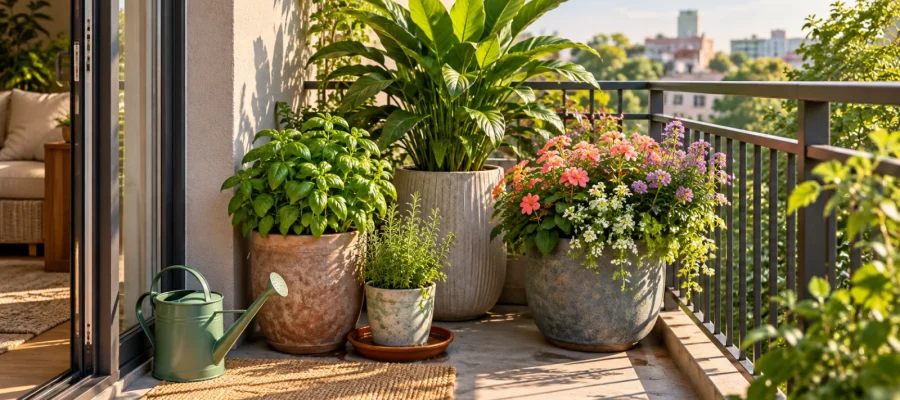
A successful balcony container garden begins with observation rather than a trolley full of plants. Record the sunlight, check building rules and decide how watering will work. A small collection matched to those conditions is easier to maintain than a crowded display that needs more light, space or daily attention than you can provide.
Map the balcony before buying plants
Observe where direct sunlight falls in the morning, around midday and later in the afternoon. Record the actual hours rather than assuming that a bright-looking balcony receives full sun. Nearby buildings, roof overhangs and seasonal changes can alter the pattern. Notice exposed corners and places where wind moves loose objects.
Check your lease or building rules for planters, drainage and attachments. Confirm permitted loading with the responsible building professional before planning heavy containers. Wet potting mix, pots and stored water all add weight. Keep access routes clear, and do not suspend containers beyond a railing without an approved system and permission.
Use the observations to create a short brief: available light, local seasonal conditions, exposure, reachable floor space and who will water during absences. That brief is more useful at a nursery than a photograph of an unrelated garden.
Choose pots and growing mix together
Select containers with an appropriate route for excess water to escape and enough root space for the chosen plants. The University of Minnesota Extension’s small-space container guidance recommends drainage holes and a suitable potting mix rather than ordinary garden soil. Its plant examples reflect Minnesota conditions, so confirm seasonal suitability locally.
Compare pots as working equipment. Can you reach inside to check moisture? Will the mature plant remain proportionate to the container? Can you move the empty pot through the doorway? Check whether a decorative outer pot conceals water collecting around an inner nursery pot.
| Choice | Practical question |
|---|---|
| One large planter | Is the filled weight permitted, and can all its plants share care? |
| Several smaller pots | Can you maintain each one without crowding the walkway? |
| Self-watering container | How are its reservoir, overflow and maintenance managed? |
| Decorative outer pot | Can you inspect and remove accumulated water? |
Match plants to care, not just appearance
Read plant labels for light, mature size and seasonal requirements. Group plants only when their water and growing conditions are compatible. A compact plant in the shop may become much wider later, so leave room for the expected growth rather than arranging pots as tightly as a display shelf.
For an illustrative three-container plan, suppose the balcony has a verified sunny zone near one end and a more sheltered, partly shaded corner. Choose one locally suitable edible plant for the sunnier position, one ornamental plant appropriate to the sheltered corner, and leave the third container unplanted until you understand the watering routine.
This staged approach gives you a small experiment without making the entire balcony dependent on untested assumptions. If plants need moving, adjust the layout before adding more. For other projects around the space, browse our garden and outdoor guides. Keep your plant choices grounded in the balcony’s measured conditions.
Build a watering routine from observation
Check the potting mix rather than watering every container automatically on the same schedule. Requirements change with the plant, container, weather and exposure. UMN Extension’s watering guidance emphasizes maintaining suitable moisture, following fertilizer labels and avoiding prolonged waterlogging in collection trays.
Make watering physically easy. Choose a can you can carry comfortably, protect the route through the home and plan how to manage runoff without affecting neighbors. If using irrigation, test it while you are home and check it regularly rather than assuming automation removes the need for inspection.
Mistakes to avoid
Avoid buying for a different climate, hiding blocked drainage inside decorative pots or introducing too many plants at once. Photograph the layout and keep the plant labels so you can identify what changed if a plant struggles.
Starter checklist
- Sunlight and exposure recorded.
- Building rules and loading questions resolved.
- Drainage and suitable growing mix planned.
- Plants matched to local conditions and mature size.
- Watering, runoff and holiday care arranged.
Frequently asked questions
Can a shaded balcony still have plants?
Often, but the available light must match the selected species. Ask a local nursery for plants suited to the actual exposure and temperature range rather than choosing plants labeled for full sun.
Do containers need watering every day?
Some may during demanding conditions; others may not. Check moisture and plant needs. A fixed daily dose can leave one container too dry and another persistently wet.
Ultimas Entradas Publicadas
Balcony Container Gardening: Sun, Pots and Watering
Closet Organizers: Measure Before Choosing a System
Bathroom Exhaust Fans: What to Check Before Buying
Peel-and-Stick Wallpaper: Wall Prep and Roll Planning
Layered Living Room Lighting: Lumens, Kelvin and Placement

Living Room Rug Sizes: Three Layouts to Test at Home
How to Measure for a Sofa Before You Buy
Quartz vs Laminate Countertops: A Practical Buying Guide
Bathroom Flooring: Porcelain Tile vs Luxury Vinyl
